
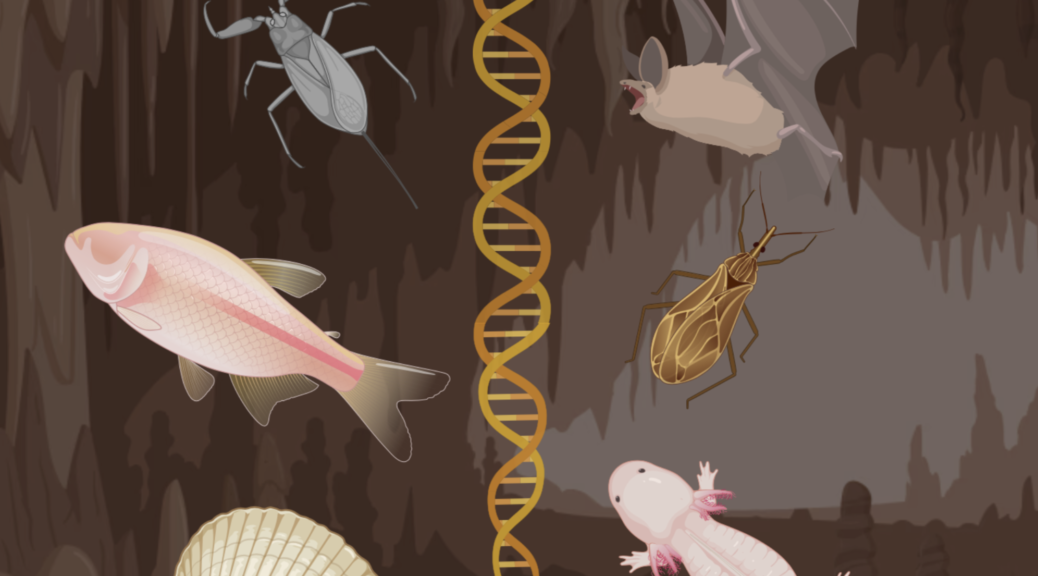
To live long it is necessary to live slowly. Attributed to Cicero
This month’s theme: Longevity of cave organisms
One of the most intriguing natural experiments in evolution happens in the dark: caves. Across the tree of life, closely related populations have repeatedly colonized subterranean environments. These cave-dwelling organisms (troglobionts) often show striking differences from their surface relatives, including reduced eyes and pigmentation, altered metabolism, and of particular interest here, changes in lifespan. So what drives this pattern?
Difference of life expectancy between cave and surface organisms
Across multiple lineages, cave-dwelling organisms tend to exhibit extended lifespans compared to their surface relatives, although the strength of this pattern varies across taxa.
The cave salamander Proteus anguinus represents one of the most extreme cases of longevity. Individuals have an average lifespan of around 70 years and may exceed 100 years, far surpassing most surface-dwelling amphibians of comparable size.
The Italian cave salamander Speleomantes italicus can live up to 25 years, which is relatively long for small amphibians and consistent with a slow life-history strategy associated with subterranean environments.
In cavefish Astyanax mexicanus, individuals can reach up to 15 years of age, exceeding the lifespan of surface populations. These fish also display prolonged reproductive capacity.
North American cavefish including Amblyopsis spelaea and Typhlichthys subterraneus are hypothesized to reach 20–30 years under natural conditions, suggesting substantial longevity potential.
Among invertebrates, the cave bivalve Congeria kusceri shows exceptional longevity, with individuals living over 50 years, a long lifespan for this group, even if some bivalves can live considerably longer, up to 500 years.
Cave crustaceans such as Orconectes australis can live for more than two decades, reflecting slow growth and reduced metabolic rates typical of subterranean species.
Similarly, the cave isopod Bahalana geracei exhibits lifespans ranging from approximately 24 to 35 years, which is unusually long for small invertebrates.
Even cave-adapted beetles such as Laemostenus schreibersi can live for more than six years, exceeding the lifespan of many surface-dwelling insects of similar size.
A similar pattern of extended longevity relative to body size is observed in Chiroptera. Bats are among the longest-lived mammals for their size, with some species living several decades despite their small body mass. For example, Myotis brandtii can live over 40 years. Although bats are not obligate cave dwellers, their ecology shares key features with subterranean environments, such as stable microclimates and reduced predation.
Extrinsic mortality and life-history evolution
The most widely accepted explanation for increased longevity in cave organisms is rooted in classical life-history theory. Subterranean environments are remarkably stable, lacking seasonal variation, light cycles, and often predators, which greatly reduces extrinsic mortality (the risk of death from external causes). Under such conditions, evolutionary theory predicts a shift in resource allocation: rather than investing in rapid growth and reproduction, organisms favor long-term survival and maintenance. This results in a suite of correlated traits, including slower growth, delayed reproduction, reduced fecundity, and ultimately extended lifespan. This pattern has been documented across multiple cave systems. For instance, cave-dwelling fish such as Astyanax mexicanus reproduce less frequently but retain reproductive capacity over longer periods, while many cave invertebrates exhibit reduced metabolic rates and prolonged developmental times, consistent with a “slow” life-history strategy.
Metabolic rate and energy limitation
Caves are energy-poor environments in which primary production is absent and food inputs are sporadic, arriving mainly through detritus. As a consequence, cave organisms have evolved to cope with chronic resource limitation. A common adaptation is metabolic depression, characterized by lower basal metabolic rates, reduced activity levels, and increased efficiency in energy use. These traits are directly relevant to longevity, as reduced metabolic rates are often associated with lower production of reactive oxygen species (ROS), which contribute to cellular damage and aging. In addition, many cave species show enhanced resistance to starvation, involving adaptations such as altered lipid storage, modifications in insulin signaling pathways, and improved stress resistance. Notably, these physiological changes overlap with key molecular pathways known to regulate longevity in established model organisms, suggesting that adaptation to energy limitation may incidentally promote extended lifespan.
Stress resistance and cellular maintenance
Cave organisms frequently exhibit increased tolerance to environmental stressors such as hypoxia, oxidative stress, and chronic nutrient deprivation, a pattern particularly well documented in cavefish and subterranean invertebrates. Enhanced stress resistance is a hallmark of long-lived organisms, and in these species it is often supported by multiple complementary mechanisms. These include the upregulation of antioxidant defenses that limit oxidative damage, improved DNA repair systems that maintain genomic integrity, and more efficient protein homeostasis (proteostasis), which prevents the accumulation of damaged or misfolded proteins. These adaptations could reduce the progressive buildup of cellular damage over time, thereby contributing to slower aging and extended lifespan in subterranean environments.
Reproductive strategy trade-offs
Another key factor is the shift in reproductive strategy. It has been noted that cave organisms show fewer offspring, larger eggs or greater parental investment, and longer reproductive intervals. This pattern reflects a classic trade-off between reproduction and maintenance. Energy that would otherwise be devoted to producing many offspring is instead redirected toward survival, repair, and overall maintenance of the organism.
Genetic and genomic changes
At the genomic level, cave adaptation is complex and still under active investigation. Several hypotheses link genome evolution to longevity in cave-dwelling species. One important aspect concerns genome size and transposable elements. Some studies suggest that cave species may differ in genome size compared to their surface-dwelling relatives, which could be associated with either the accumulation or reduction of transposable elements, as well as changes in repetitive DNA content.
However, the relationship between genome size and longevity is not straightforward. Larger genomes can impose metabolic costs, such as slower cell division, but they may also play a role in gene regulation and genomic stability. As a result, genome evolution in cave species may contribute to longevity in indirect and highly context-dependent ways.
Is there still a limit to lifespan?
Even in very stable environments, the lifespan of organisms remains limited. This can be explained by a combination of evolutionary and biological factors. From an evolutionary perspective, natural selection is stronger on traits affecting early reproduction than on those acting later in life, which allows for the accumulation of deleterious mutations linked to aging. At the same time, constant pressures such as parasites, pathogens, and ecological interactions may drive ongoing coevolution, reinforcing the importance of generational renewal. Finally, at the biological level, organisms inevitably undergo progressive molecular damage that cannot be fully repaired with current scientific knowledge.
Conclusion
Cave systems provide a powerful natural framework for studying aging because they combine several key advantages: repeated and independent evolutionary events through multiple cave colonizations, clear environmental contrasts between surface and subterranean habitats, and closely related taxa that nonetheless display strongly divergent life histories.
Together, these features make cave organisms particularly valuable for testing fundamental questions in evolutionary biology and gerontology. They allow researchers to explore how environmental pressures shape the evolution of lifespan, to identify the genetic and physiological changes associated with extended longevity, and to investigate whether there are universal mechanisms of aging shared across different taxa.
The good news of the month: Cloning does not reduce life expectancy
A new study published in Nature Communications explored the long-term limits of mammalian cloning by serially cloning mice over 20 years and 58 generations. Surprisingly, the cloned mice remained healthy and had normal lifespans despite accumulating genetic mutations over time. Even more interesting, when these late-generation clones reproduced sexually, many of the accumulated abnormalities were naturally corrected in the next generation. The study highlights the remarkable resilience and “repair capacity” of sexual reproduction, offering new insights into genetic stability, fertility, and the mechanisms that help preserve healthy aging across generations.
News of Heales and the Longevity Community: ARDD conference in Boston in October 2026.
The Aging Research and Drug Discovery Conference (ARDD), one of the leading global conferences in longevity science, will not take place in Copenhagen this year as originally planned. Instead, the event is expected to be relocated to Boston (21 – 23 October) and integrated into a broader series of events during Boston Longevity Week.
For more information