
“If you would live long, choose your ancestors well”. A Cournil , T B Kirkwood
This month’s theme: Genes for Longevity
Introduction
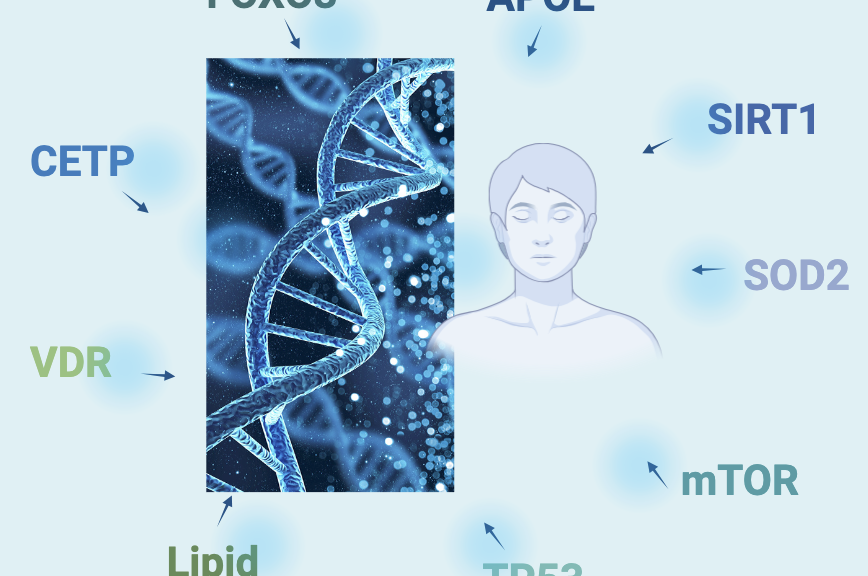
Genes associated with longevity are those that influence cellular maintenance, stress resistance, metabolism, and repair processes, helping organisms live longer and healthier lives. Key examples include FOXO genes, which regulate stress responses and protect against cellular damage; SIRT genes (sirtuins), involved in DNA repair and metabolic control; and mTOR, a pathway that links nutrient availability to growth and aging, where reduced activity is often associated with increased lifespan. Other important players include telomerase (TERT), which maintains chromosome stability, and genes involved in antioxidant defense and DNA repair. Together, these genes do not act alone but form interconnected pathways that determine how well cells resist damage over time, making them central targets in aging research and potential interventions to extend lifespan.
FOXO3 — The Cellular Survival Strategist FOXO3 is often considered the star player among longevity genes, and for good reason. It encodes a transcription factor—a protein that turns other genes on or off—particularly those involved in stress resistance, metabolism, and cell repair. When cells face challenges like oxidative stress (damage from free radicals), FOXO3 activates protective pathways that enhance DNA repair, regulate the cell cycle, and even trigger the removal of damaged cells. It is tightly linked to the insulin/IGF-1 signaling pathway, one of the most important biological systems controlling aging across species. Variants such as rs2802292 have been repeatedly associated with longer lifespan and healthier metabolic profiles, suggesting that individuals with favorable versions of FOXO3 may be better equipped to maintain cellular integrity over time .
APOE — The Disease Gatekeeper APOE plays a central role in lipid (fat) transport and cholesterol metabolism, but its real significance in longevity lies in disease prevention. Different versions (alleles) of this gene—ε2, ε3, and ε4—have dramatically different effects. The ε2 variant is associated with increased lifespan, largely because it lowers the risk of Alzheimer’s disease and cardiovascular conditions, two of the leading causes of death in older adults. In contrast, ε4 increases disease risk and is linked to shorter average lifespan. Rather than directly slowing aging, APOE influences how well the body avoids major age-related diseases, making it a key “gatekeeper” gene for healthy aging.
SIRT1 — The Metabolic Longevity Switch SIRT1 belongs to the sirtuin family of proteins, often described as “longevity regulators.” It is activated under conditions of low energy availability—such as fasting or calorie restriction—and helps cells adapt by improving efficiency and resilience. SIRT1 promotes DNA repair, reduces inflammation, enhances mitochondrial function, and increases resistance to oxidative stress. These effects collectively mimic the biological benefits of calorie restriction, one of the most robust lifespan-extending interventions observed in animal studies. Genetic variants in SIRT1 have been linked to differences in metabolism and age-related disease risk, highlighting its role as a molecular bridge between diet, energy balance, and aging .
SOD2 — The Mitochondrial Bodyguard SOD2 encodes an enzyme located in the mitochondria—the energy-producing structures inside cells. Its job is to neutralize reactive oxygen species (ROS), harmful byproducts of energy metabolism that can damage DNA, proteins, and cell membranes. Over time, unchecked oxidative stress contributes to aging and many chronic diseases. By converting these reactive molecules into less harmful substances, SOD2 acts as a frontline defense against cellular damage. Variants in this gene can influence how effectively cells manage oxidative stress, thereby affecting susceptibility to aging-related decline .
SIRT1, mTOR, and the Nutrient-Sensing Network — The Aging Control Hub Beyond individual genes, longevity is strongly influenced by entire signaling pathways, particularly those that sense nutrient availability. SIRT1 works alongside pathways like mTOR (mechanistic target of rapamycin), which regulates growth and metabolism based on nutrient levels. When nutrients are abundant, mTOR promotes growth and reproduction; when scarce, reduced mTOR activity shifts the body toward repair and maintenance. This balance is crucial: excessive mTOR activity is linked to aging and disease, while its inhibition (as seen in calorie restriction or certain drugs like rapamycin) is associated with lifespan extension. Together, these pathways form a central “control hub” that determines how the body allocates energy between growth and longevity .
TP53 — The Genome Protector TP53, often called the “guardian of the genome,” is best known for its role in preventing cancer. It monitors DNA integrity and can halt cell division or trigger cell death if damage is detected. While this function is essential for preventing tumors, it also has complex effects on aging. On one hand, strong TP53 activity protects against cancer; on the other, excessive activation may accelerate aging by limiting cell renewal. Variants in TP53 are being studied for their role in balancing these opposing effects, making it a key gene at the intersection of longevity and cancer biology .
CETP, Lipid Genes and VDR
Genes involved in lipid metabolism and vitamin D signaling play a key supporting role in longevity by maintaining overall health. helps regulate the balance between HDL (“good”) and LDL (“bad”) cholesterol, with certain variants linked to lower cardiovascular risk and longer lifespan. In parallel, governs the body’s response to vitamin D, influencing bone health, immune function, and inflammation. Together, these pathways contribute indirectly to longevity by reducing the burden of chronic disease and supporting long-term health.
Supercentenarians
Supercentenarians often carry beneficial variants in genes like FOXO3, which improves cellular stress resistance and repair through insulin signaling pathways, and SIRT1, which supports DNA repair, metabolism, and anti-inflammatory processes. The APOE ε2 variant is frequently associated with longer life because it lowers the risk of Alzheimer’s and cardiovascular disease, helping individuals avoid major age-related illnesses. Genes such as SOD2 protect against oxidative damage in mitochondria, while TP53 maintains DNA integrity and reduces cancer risk. Together, these genes form a network that promotes efficient maintenance of cells and reduces disease burden, allowing some individuals to reach extreme ages.
Extreme longevity in supercentenarians results from a combination of protective genetic variants, especially those enhancing stress resistance and disease prevention. These genes don’t act alone—they work together with environment and lifestyle to enable exceptionally long, healthy lives.
Insights from the longest-lived species
A recent study published in Nature sheds light on the extraordinary longevity of the bowhead whale, which can live for more than 200 years. Researchers identified enhanced activity of genes involved in DNA repair and stress response, notably CIRBP (Cold-Inducible RNA Binding Protein), which helps protect cells against genotoxic stress, as well as adaptations in ERCC1 and other DNA repair pathways.
The naked mole-rat is another powerful model, known for its long lifespan and cancer resistance. It exhibits unique regulation of genes such as HAS2, responsible for producing high-molecular-mass hyaluronan that enhances tissue integrity and suppresses tumor formation. In addition, tumor suppressor pathways involving TP53 and CDKN2A are unusually robust in this species, contributing to enhanced control of cell proliferation and damage response.
The greenland shark, with a lifespan exceeding 400 years, shows genetic adaptations in pathways linked to DNA repair and metabolic stability. Studies point to modifications in genes such as RAD50 and ATM, which are involved in detecting and repairing DNA damage, as well as genes regulating oxidative stress responses.
Finally, the Turritopsis dohrnii demonstrates a unique form of biological “immortality” through its ability to revert to an earlier life stage. This process involves genes linked to cellular reprogramming and pluripotency, including SOX2, MYC, and NANOG, as well as enhanced DNA repair genes like PARP1.
Conclusion
We do not know exactly why we age. But we know that the maximal lifespan is determined principally by our genes. That’s why we live until 120 years, the mice a maximum of 4 years and the Galapagos tortoises a maximum of 200 years. One day maybe a gene therapy could change our limits.
The good news of the month: Life expectancy of cloned mice does not decrease. First human clinical trial of “partial cellular reprogramming” for people with glaucoma.
A remarkable long-term study shows both the power—and limits—of cloning in mammals. Over 20 years, scientists led by Teruhiko Wakayama successfully cloned mice for up to 58 generations from a single individual, with many animals appearing healthy and living normal lifespans. Subtle genetic mutations accumulated over time, eventually reducing cloning success and halting the process. However, interestingly, the lifespan of successive generations of cloned animals did not decrease. Encouragingly, natural reproduction was able to “reset” many of these defects, highlighting the body’s intrinsic ability to maintain genetic health. The findings suggest that while cloning and cellular reprogramming hold huge promise, biology still relies on built-in repair mechanisms—offering valuable insight for future longevity and regenerative therapies.
Recent advances in longevity science are moving from theory to reality, as the first human clinical trial of “partial cellular reprogramming” is set to begin this year. Researchers have shown in animals that it’s possible to rewind cells to a more youthful state without erasing their identity. In mice, this approach has improved tissue regeneration, restored vision, and even extended lifespan. Now, a biotech company called Life Biosciences will test whether this method can safely repair optic nerve damage in people with glaucoma.
News of Heales and the Longevity Community: ARDD conference in Boston in October 2026.
The Aging Research and Drug Discovery Conference (ARDD), one of the leading global conferences in longevity science, will not take place in Copenhagen this year as originally planned. Instead, the event is expected to be relocated to Boston (21 – 23 October) and integrated into a broader series of events during Boston Longevity Week.
For more information