
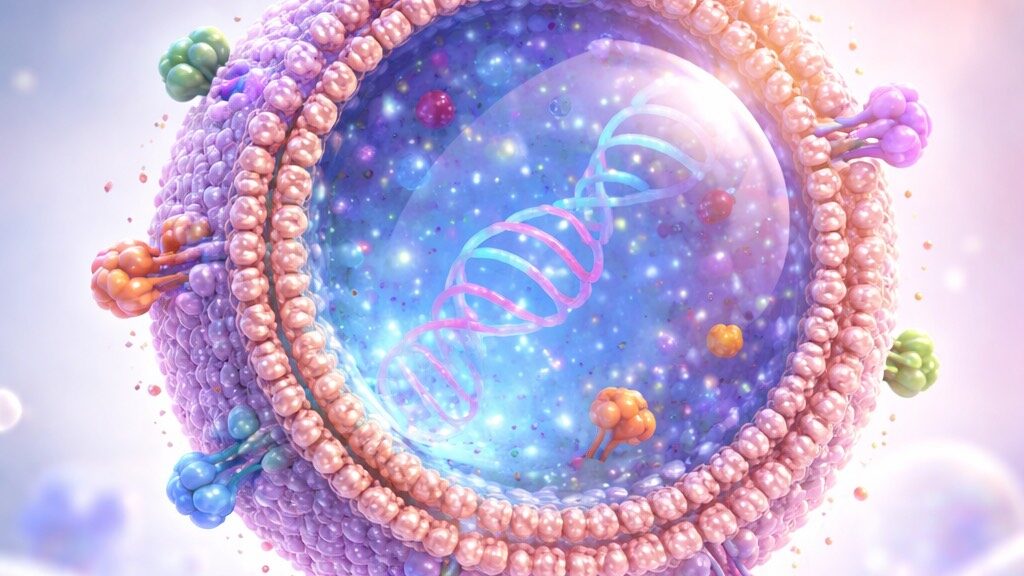
The next revolution in biology isn’t reading life’s code — it’s writing it.(…) Sequencing let us read the book of life, our instruction manual. Synthesis will allow us to write new chapters, if not entirely new books. (…). Writing DNA holds even greater promise, the potential to cure any disease. Andrew Hessel. October 20, 2025. Big Think.
This month’s theme: Exosomes and Longevity
Exosomes are tiny membrane-bound vesicles released by cells that act as messengers between cells. Measuring about 30–150 nanometers, they form inside the cell and are released into body fluids such as blood and saliva. Exosomes carry proteins, lipids, and genetic material like RNA, which can influence the behavior of recipient cells by altering processes such as inflammation, immune responses, blood clotting, tissue repair, and aging. Because their contents reflect the state of the cells they come from, exosomes are important in research as biomarkers for disease and are being explored as potential therapeutic delivery vehicles.
Exosomes play an important role in the aging process by mediating the transfer of nucleic acids, lipids, and proteins between cells across a wide range of organisms. These vesicles exert significant gerontological effects, influencing cellular function and systemic aging. Exosomes derived from young or stem cells are enriched with antioxidant factors and anti-inflammatory cytokines that help counteract age-related cellular damage. Notably, conditions such as nutrient restriction stimulate exosome release, which has been shown to delay cellular senescence in vitro and slow aging processes in vivo. This effect is thought to occur through enhanced removal of damaged cellular components, including fragmented DNA, misfolded proteins, and oxidized biomolecules, in both animal models and humans. Collectively, these findings underscore the critical role of exosome-mediated waste clearance in aging biology and provide mechanistic support for the longevity benefits associated with fasting and metabolic stress, highlighting promising directions for future research into cellular maintenance and longevity interventions.
As a Longevity Therapy
Exosomes are rapidly emerging as one of the most exciting areas in longevity science. In recent years, researchers have discovered that many of the benefits associated with stem cell therapy are not due to the cells permanently integrating into tissues, but rather to the signals they release. These signals are largely carried by exosomes. This insight has shifted attention toward exosome-based therapies, which offer many of the regenerative benefits of stem cells without the complexity or risk associated with live cell transplantation.
Exosomes derived from mesenchymal stem cells (MSCs) are of particular interest in longevity research. They have also shown promise in areas such as skin rejuvenation, joint health, neuroprotection, and metabolic regulation. Because exosomes carry molecular “instructions” from their parent cells, they can influence aging pathways linked to cellular senescence, mitochondrial function, and repair mechanisms.
Another compelling aspect of exosomes is their potential role as biomarkers of aging. Their molecular cargo reflects the physiological state of the cells they originate from, making them valuable tools for monitoring biological aging and disease progression. At the same time, their natural stability and low immunogenicity make them attractive candidates for therapeutic delivery.
While exosome-based longevity therapies are still largely in the research, interest is rapidly growing. Clinical trials are underway, and exosome treatments are already being offered in some settings, though standardized protocols and long-term safety data are still needed. Ongoing research is focused on refining isolation techniques, improving quality control, and understanding how to best harness exosomes for targeted, personalized therapies.
As science continues to uncover how exosomes influence aging and regeneration, they are increasingly viewed as a key component of future longevity medicine—offering the possibility of extending not just lifespan, but healthspan.
Exosomes as a therapy for other diseases
In 2026, the exosome therapy landscape features over 70 active companies developing more than 80 pipeline therapies for regenerative medicine, oncology, and rare genetic diseases. Key companies leading the development of exosome-based therapeutics include:
Capricor Therapeutics: A clinical-stage company using its StealthX platform for precision medicine. Its lead candidate, CAP-1002, is currently in advanced trials for Duchenne Muscular Dystrophy.
Aruna Bio: Uses neural-derived exosomes to cross the blood-brain barrier. It initiated Phase Ib/IIa clinical trials for AB126 in acute ischemic stroke in late 2024.
ILIAS Biologics: Developed the EXPLOR platform for loading large therapeutic payloads. Its candidate ILB-202 completed Phase I trials for inflammatory conditions in 2023. EXO Biologics: A clinical-stage Belgian company that secured Series A funding in April 2024 to scale manufacturing and clinical supply for its therapeutic pipeline.
Coya Therapeutics: Developing COYA 201, a therapy leveraging regulatory T-cell (Treg) derived exosomes for neurodegenerative and autoimmune diseases.
NurExone Biologic: In early 2025, the company acquired a master cell bank to ensure a scalable supply for treating spinal cord and acute injuries.
Brexogen: Evaluating BRE-AD01 for atopic dermatitis and BRE-MI01 for myocardial infarction. Direct Biologics: Known for ExoFlo, an intravenous exosome therapy used in clinical trials for severe respiratory conditions.
A recent study led by Nicolás Cherñavsky, a researcher working with Heales, looked at whether exosomes and other extracellular particles from young pigs can be safely injected into rats. The goal was to check if this kind of cross-species approach triggers any immediate immune or toxic reaction. Over nine days, the treated animals showed normal behavior, normal weight gain, and no signs of inflammation or organ damage. Detailed tissue analyses confirmed the absence of acute toxicity in the liver, kidneys, and spleen. These results add to the growing body of research suggesting that exosomes from young organisms may cross species barriers without causing short-term immune reactions. This is an encouraging step for future longevity and rejuvenation studies.
Scientific consensus increasingly aligns with the theory that exosomes function as powerful signaling vectors capable of activating internal self-repair mechanisms. These nano-sized vesicles carry a specialized “cargo” of proteins, lipids, and microRNAs (miRNAs) that act as “biological instructions” to reprogram recipient cells toward a more youthful functional state. Research into heterochronic parabiosis has demonstrated that exosomes from young sources—specifically young plasma or stem cells—can reverse age-related phenotypes at molecular, mitochondrial, and physiological levels. By delivering “youth signals” like miR-144-3p and miR-455-3p, these vesicles can significantly downregulate senescence markers such as p16 and p21, while simultaneously upregulating genes associated with telomerase activity and mitochondrial health, effectively telling the cell to resume the repair processes characteristic of early age.
The good news of the month- Mice living almost 5 years due to “telomere rivers”
Telomere Rivers—immune-derived particles that transfer rejuvenating signals between cells. Produced by CD4⁺ T cells, they deliver telomeric DNA and systemically, reversing aging independently of telomerase. Unlike plasma-based or cell-limited effects, Rivers act as a coordinated, immune-driven rejuvenation system, suggesting T cells play a central role in maintaining youth and enabling transferable, organism-wide rejuvenation.
If it is true, this is the most important longevity news in years. However, this is only a preprint and there are some problems in the information given. To be followed.
News of Heales and the longevity community
Heales will organize the 8th Eurosymposium on healthy ageing / longevity. It will be In Brussels and online : Wednesday, November 4th, till Friday, November 6th 2026.
For more information