
No one has identified a safe level of PFAS chemicals. Robert Bilott, environmental attorney (Dark Waters). Source (May 20, 2025).
This month’s theme: PFAS and longevity
What are PFAS and why are they called “forever chemicals”?
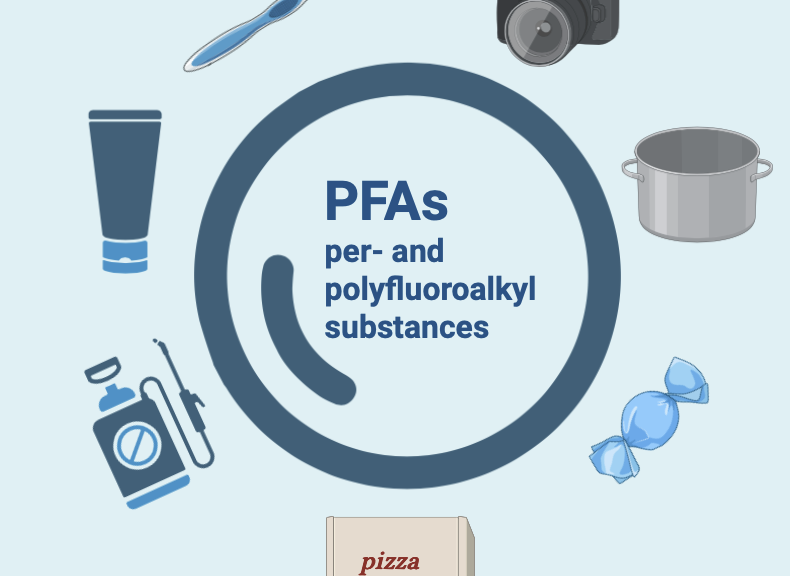
Per- and polyfluoroalkyl substances (PFAS) are a large family of thousands of synthetic chemicals that have been widely used since the 1940s to make products resistant to water, grease, stains, and heat. They can be found in everything from nonstick cookware and waterproof clothing to food packaging, cosmetics, and firefighting foams.
PFAS are often referred to as “forever chemicals” because many of these compounds are extremely persistent. They break down very slowly in the environment and can accumulate in soil, water, wildlife, and the human body over time. Growing scientific evidence has linked exposure to certain PFAS with a range of health concerns, including elevated cholesterol, impaired immune function, thyroid disorders, liver damage, reproductive and developmental effects, and an increased risk of some cancers.
As awareness of these risks has grown, governments around the world have begun introducing stricter regulations and phasing out some of the most well-studied PFAS, while researchers continue to investigate the safety of newer alternatives and strategies to reduce human and environmental exposure.
How PFAS affect major organs:
- Liver – PFAS accumulate here, disrupting a lipid-regulating protein (PPAR-α), which drives up cholesterol and fatty liver disease. Liver enzymes often rise with exposure.
- Kidney – Also a major accumulation site; linked to kidney cancer and chronic kidney disease.
- Immune system – Reduces vaccine antibody response (best-documented effect). One mechanism: PFOS triggers an inflammatory pathway (AIM2 inflammasome) causing cell death and tissue damage in liver, lung, and kidney.
- Thyroid – Disrupts thyroid hormone regulation, linked to hypothyroidism, notable since thyroid function correlates with life expectancy.
- Reproductive system – Linked to preeclampsia, lower birth weight, reduced fertility, and testicular cancer.
- Cardiovascular – Consistently raises cholesterol and disrupts insulin regulation.
- Brain– PFAS exposure can disrupt neuroendocrine signaling that regulate neurotransmitter systems, potentially resulting in neurological diseases
How does it affect Longevity?
A study in Frontiers in Aging analyzed blood and DNA data from 326 older U.S. adults and used 12 epigenetic clocks to measure biological age. The researchers, led by Dr. Xiangwei Li at Shanghai Jiao Tong University, found that two specific PFAS compounds. PFNA (perfluorononanoic acid) and PFOSA (perfluorooctanesulfonamide) appear to accelerate biological aging, with middle-aged men showing the most vulnerability. The effect was strongest in men and in adults aged 50 to 64, and was measured via DNA methylation clocks. Li noted these newer PFAS alternatives aren’t necessarily safer replacements for older, phased-out compounds.
Why this matters broadly
The Environmental Working Group estimates more than 200 million Americans may have PFAS in their drinking water. Exposure is thus widespread rather than niche. Epidemiological research has already linked exposure to certain cancers, reduced immune function, and developmental problems in children.
There’s also a 2024 study linking PFAS exposure to faster biological aging in a much larger sample (~15,000 adults).
Regulatory context
United States Environmental Protection Agency set enforceable drinking water limits for six PFAS chemicals in 2024, but those regulations were partially rolled back in May 2025. In 2026, at least 31 states are expected to consider their own PFAS policies, ranging from product bans to water standards. The European Union enforces strict, legally binding limits on per- and polyfluoroalkyl substances (PFAS) across multiple sectors, including a harmonized drinking water limit of 0.1 μg/L for the sum of all PFAS.
Beyond individual health, PFAS create broader societal costs:
- Massive economic burden.
- Water contamination at scale
- Remediation is extremely expensive and hard
- Costs fall at the moment on ordinary people, not producers. Individuals face higher utility bills (water treatment), falling property values in contaminated areas, and higher prices for PFAS-free alternatives while producer profits (PFAS is a lucrative ~$4 billion/year industry) are largely shielded from these costs.
- Environmental/ecosystem damage.
- Regulatory and legal strain. Litigation and compliance costs are projected to consume hundreds of billions from the U.S. economy over the next decade, and there’s active scientific/political debate about whether current regulatory thresholds are justified, creating policy uncertainty.
A global analysis of over 45,000 water samples found a large share of surface and groundwater worldwide exceeds international PFAS safety advisories. European Chemical Agency estimates 4.4 million metric tons of PFAS will be released into the environment globally over the next three decades if current practices continue. Major PFAS manufacturing remains concentrated in the US, Europe, China, and Japan, but PFAS-intensive industries (electronics, batteries, semiconductors) are increasingly shifting to developing countries, raising concern that pollution burden is being exported to nations with weaker regulation, even as PFAS-contaminated goods get re-imported into regulated markets like the EU. Global regulation is accelerating but remains inconsistent creating both compliance complexity for manufacturers and uneven public health protection depending on where people live.
REACH (registration, evaluation, authorisation and restriction of chemicals)
The EU’s PFAS restriction under REACH began in January 2023, when Denmark, Germany, the Netherlands, Norway, and Sweden submitted a proposal covering the entire PFAS class (over 10,000 substances) across nearly all uses (firefighting foams were split off and restricted separately in October 2025). After a lengthy scientific review involving over 5,600 stakeholder comments, ECHA’s Committee for Risk Assessment finalized its opinion supporting restriction, and in March 2026 the second committee (Socio-Economic Analysis) opened a public consultation on its draft opinion, running through May 2026, with a final opinion due by the end of 2026. Once that’s complete, the European Commission has three months to draft binding legislation, which still needs Member State approval. Thus, actual enforceable law likely won’t arrive until 2027 or later.
Rather than an outright ban, the current approach allows continued use of certain PFAS where risks are deemed “controlled,” with time-limited exemptions of up to 12 years for essential uses lacking safer alternatives. Meanwhile, individual countries like Denmark are moving faster with their own national bans, such as prohibiting PFAS-treated clothing and footwear starting July 2026.
Conclusion
PFAS are a textbook case of a problem that longevity thinking should take seriously: not a dramatic, sudden threat, but a slow, silent, cumulative one. These molecules don’t kill quickly. They raise cholesterol, disturb the thyroid, weaken immune defenses, and, as recent epigenetic work suggests, quietly accelerate biological aging. In other words, they work against healthy longevity in exactly the diffuse way that is hardest to notice and easiest to neglect.
The encouraging part is that awareness is turning into action. Europe’s REACH restriction, national bans moving faster than the EU timetable, and drinking-water limits are all signs that a “forever” problem is at last being treated as a solvable one. For the longevity community, the lesson is consistent with our broader message: extending healthy lifespan is not only about new therapies, but also about removing the accumulated damage, chemical, environmental, and biological, that shortens it. Cleaner water and cleaner chemistry are, quite literally, longevity interventions. And as this month’s good news shows, even damage long considered permanent may not stay that way.
The good news of the month: Glycation: What was “irreversible” may no longer be forever
On 14 July 2026, Nature Communications published “Reversal of protein chemical aging by enzymatic deglycation“, from Revel Pharmaceuticals with collaborators at Calico and the University of Colorado Anschutz Medical Campus. The team engineered an enzyme, CMLase, through directed evolution across more than 500 million variants of a bacterial glycine-oxidase scaffold. CMLase targets Nε-carboxymethyl-lysine (CML), one of the most abundant advanced glycation end products (AGEs), the sugar-protein “browning” damage that stiffens skin, blood vessels and other long-lived tissues over a lifetime.
Since the 1980s this damage has been considered a permanent hallmark of aging. In this proof-of-concept, CMLase reversed it in human tissue from elderly donors, cutting CML by more than 70% in a 75-year-old donor’s arterial tissue and by over 55% in aged skin
But this experience is only on human tissues. If this is confirmed, it would shift the central question of the field from “How do we slow the damage?” to “How do we repair it?”
News of Heales and the Longevity Community: Lithuania. Healthy Ageing and Longevity Assembly 2026
The Healthy Ageing & Longevity Assembly 2026 brought together scientists, clinicians, policymakers, and community leaders across Lithuania for a week-long series of events dedicated to advancing healthy longevity. The assembly highlighted the growing momentum behind evidence-based longevity medicine, aging research, and cross-sector policies aimed at extending healthy lifespan in Europe and beyond.
For more information