
The Gompertz curve and aging. The death of death. June 2018. N° 111.

Expressions such as “healthy aging” and “aging gracefully” signify that (…) you’re relatively healthy and/or the cosmetic signs of aging aren’t as pronounced as they could be. (…)

This choice of words is rather problematic, especially now that the dawn of rejuvenation is visible on the horizon. The terms “healthy aging” and “successful aging” really are sharp contradictions in terms. If you read the scientific literature on aging, most if not all papers giving general introductions to the phenomenon define it as a chronic process of damage accumulation or a progressive decline in health and functionality. If we try to replace these definitions in the two expressions above, the results are frankly hilarious: “a healthy chronic process of damage accumulation” and “a successful progressive decline in health and functionality”. What’s that even supposed to mean?

Nicola Bagalà, mathematician, artist and life extensionist from the Life Extension Advocacy Foundation (LEAF) in the article Getting sick in a healthy way.


Theme of the month. The periodic doubling of the risk of dying


Exponential growth in the risk of dying in humans
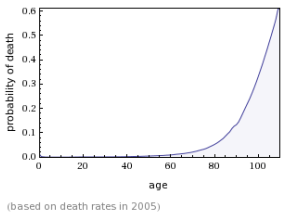
William Makeham was a British actuary and mathematician who lived in the 19th century. He was the first to discover that, for adults, the probability of dying from disease doubled at regular intervals. Represented by a line on a diagram, the risk of death thus follows an exponential upward curve, gentle at first and then increasingly steep.

This “law” of human mortality is called the Gompertz–Makeham model.

Doubling of mortality occurs approximately every 8 years. In other words, a 70-year-old is about twice as likely to die in their seventy-first year as a 62-year-old is likely to die in their sixty-third year.

In 2018, we live much longer on average than in the 19th century. It seems, however, that Gompertz-Makeham’s law is highly independent of medical progress. When life expectancy increases, mortality curves follow broadly the same logic as before but starting at a greater age.

Understanding this mechanism has been and is still useful for researchers and entrepreneurs who calculate the multiple economic factors influenced by average lifespan. This ranges from insurance premiums to the financing of social security and demographic prospects. On the other hand, the general public is unaware of this, seeing aging as a rather random phenomenon.

Exponential increase in the risk of death in other animals

For animals in captivity (or cultivated plants) therefore without risk of predation, the pattern of the risk of death with age varies. Three broad categories can be distinguished:

  • Animal species that have a fairly precise life span. They are often in good health until reproductive age or until the end of the summer and then die quickly. This is the rule for many insect species and for so-called annual plants. The best-known vertebrate in this regard is probably the salmon, but there is also a species of marsupial, the antechinus in which the male dies very quickly after reproduction.
  • Living species, especially plants, that have no known senescence mechanism or that do not have exponential growth in the probability of dying with age. This applies to tree species, including the redwood, as well as lobsters and some bivalves.
  • Species that, like humans, have an exponential growth in the probability of death.

For species with an exponential increase in the risk of dying, the mortality doubling period will almost always be shorter than in humans since very few animal species have a maximum life span as long as ours.

Generally, anti-aging experiments involve mice or rats. By knowing the mortality tables of these rodents, it is easier to evaluate the effectiveness of a treatment in fighting senescence by comparing the death curves with or without the new therapy without having to wait for the death of all the animals.

Also, given the increasing probability of death with age, it is more useful and easier to examine older animals than younger ones. If a new product or therapy is effective (i.e. increases lifespan), a difference in mortality will appear more rapidly when comparing groups of older mice (more fragile and dying more often) than when comparing groups of young mice.

However, there is a financial barrier to research on older animals: laboratory animals cost more if they are older (because they have to be raised to the right age).

The exponential growth in the risk of death is general for an individual but also specific for most conditions.
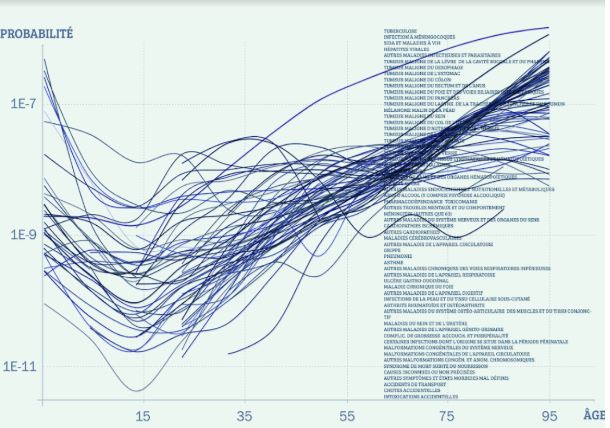
Gompertz-Makeham’s law is little known. What is even less known is that this law also applies, with nuances, to most causes of mortality. The diagram above shows the probability of death by age for most causes of mortality on an exponential scale. Whether it is the risk of dying from cancer, cardiovascular disease or neurodegenerative disease, in each case the probability of death increases with age. Even for infectious diseases, the probability increases exponentially. No one thinks that a simple bout of flu is an age-related illness and yet the risk of dying from it is much higher in an elderly person than in a young person.

The Gompertz curve is explained, of course, by all the aging mechanisms that accumulate and ultimately cause death. When therapies can be studied and then put through double blind tests under rigorous scientific conditions, it is conceivable that the exponential progression will be slowed down and indeed perhaps one day will cease to exist.


News of the month : Right to try in the USA for people suffering from incurable diseases


New legislation has just been adopted at federal level in the United States under the name of Right to try. It allows, under certain conditions, people with incurable diseases to try innovative therapies. Some say that this legislation will save patients’ lives thanks to medical advances without having to wait for a bureaucratic approval procedure.

Unfortunately the new legislation in question is still very limited, particularly as regards information on new therapies. Pharmaceutical companies are not obliged to deliver care and have no obligation to publish the results of new treatments in terms of patient survival.

More rigour therefore remains to be obtained in terms of transparency, but awareness of the importance of accelerating medical research for citizens’ health is progressing.


For more information:

Source of the illustrations : simple curve in the first illustration : awesci.com/gompertz-law-dreadful-law-death, complex curves in the second illustration supplied by LongLongLife.

The side effects of a much longer life in good health. The death of death. May 2018. N° 110. 


The financing difficulties (in the fight for longevity) are due to the desperation that almost all people have to put ageing out of their minds and pretend that it is some kind of blessing in disguise, so that they can get on with their miserably short lives without being preoccupied by the terrible thing that awaits them. This attitude is psychologically understandable but morally inexcusable… Aubrey de Grey, the world’s best-known and most active biogerontologist, Varsity (Cambridge University online journal). Interview, 27 April 2018.


Theme of the month: The consequences of a world with negligible senescence)


This letter concerns the most likely and desirable social, economic and cultural consequences of a much longer healthy life. It is based on the hypothesis that a therapy that makes senescence mechanisms negligible is accessible at a modest price (a bit like the price of vaccines or an appendix operation today). It is also assumed that the technological and cultural environment is similar to ours. If this letter were a literary short story, it would be alternate history (what would the world be like if we didn’t age today) rather than prospective, future history (what will the world be like if we don’t age in 30 years’ time).

This letter is deliberately positioned in expectation of positive developments. However a positive collective use of medical and social advances is not guaranteed. A society of ‘amortals’ and servile mortals is conceivable. Vaccination could have been used to protect soldiers invading artificially contaminated countries, organ transplantation could be done by executing poor people to give a better life to the rich, blood transfusion could be reserved for deserving workers to ‘boost’ their ability to work. However, all this is unlikely in a contemporary world where there is increasing respect for human life.

Here are the possible side effects of amortality in a world, after all, not so different from ours:

Unintentional inequalities in the face of death are rare, longevity is accepted by religious representatives, but there are “Amish of longevity”

Some imagine that a society where it is possible not to age would be divided into two camps: the moderns and traditionals. In fact nothing obliges the “traditionals” today to have electricity, running water, central heating, internet access and a smartphone. All this is radically “unnatural” and all this is very useful and has become or is becoming universally used. Nor do “traditional” people have to see a doctor when they are seriously ill, yet almost everyone does. There is no reason why the use of longevity therapy should have to be obligatory. In a world where longevity therapies are available, it is likely that they will be used by almost everyone with that slight sense of vertigo that we sometimes feel when we see a historical documentary or read a book from the past where everything was so different and, in many ways, atrocious.

Religious representatives would not oppose it any more than they have opposed vaccinations, painless childbirth, organ donation etc. once it has become widespread. Of course, none of this is explicitly provided for in the sacred books, but none of it is explicitly prohibited either. The sacred books speak of the obligation of dying of old age, but what if it no longer existed? These books also say that the slave must obey his master. When death from old age no longer exists, when slavery no longer exists, we no longer need to submit to it. Equality and longevity are concepts for which great religions can easily find theological bases.

However, there would probably be a few people who would like to continue to age. In societies with a democratic tradition, this diversity is not only manageable, it is desirable. The Amish of the eastern United States teach us many things about a population reducing access to certain technologies; people who wish to age when it is avoidable will teach us the social, health and moral consequences of an otherwise lost world.

Much more investment in personal health and safety

A human life has a price, even if that has to be couched in careful language so as not to shock. There is even a technical term which is much-used for calculating it, known as QALYs for “quality-adjusted life years”. It refers to the number of years a person has left to life, weighted according to quality of life. If aging becomes negligible, the financial value of a human life is multiplied by a factor of 10 or more in a country like France (as compared to now). On the one hand, life expectancy would no longer be measured in decades but in centuries; on the other hand, the majority of incapacitating diseases (in particular Alzheimer’s disease) would disappear or become exceptional.

This means, in purely economic terms, that a human life is more valuable and that financial efforts to save lives are much more “profitable” economically. In other words, more money and energy would be invested to prevent road deaths, to limit accidents at work and domestic accidents and to prevent deaths in natural disasters because life would be more precious than ever. Some even argue that life will be too precious, that individuals would no longer dare take any risk. It is not unimaginable that some will feel restricted by safety measures, just as many citizens in the past have rejected speed limits on the road or fire-prevention measures. But the priority is to protect the community from the actions of a minority in a world in which technological progress is a source of social progress but also entails considerable risks.

A lot more financing

This letter assumes that longevity therapy will be inexpensive. The reasons for this are that a therapy applied to billions of people has a very low marginal cost per individual and that medical therapies of any kind are much more expensive to discover than to apply. Research is expensive, medical infrastructure is expensive, pharmaceutical companies and some medical professions are highly paid, but the products and therapies themselves have a very reasonable cost.

Spending would be low while at the same time healthcare cost savings would be immense. Indeed, until now, the bulk of healthcare costs have been concentrated on treatments due to age-related diseases during the last years of life. In the hypothesis envisaged, this will only concern a small number of people. The savings will not only include healthcare as such but also a radical reduction in costs for retirement homes, support for the elderly, measures enabling families to care for suffering relatives etc.

Some are concerned about a possible “ban on choosing to age” because of economic costs. In fact, given the considerable savings that would be made, the financial means freed up for those who would choose to continue aging would be considerable. These financial resources, in an otherwise unchanged world, would also free up millions of people who could devote themselves to other socially useful tasks such as assisting people in psychological difficulty. It would also allow for the organization of a real “culture of leisure” where citizens could have a good time with their “young” parents rather than feeling guilty about “abandoning” them during the holidays.

Life more precious psychologically

To die is nothing, but to see others die, oh! to see people die… could be lines from a song by Jacques Brel. The human being is the only living being aware of the inevitability of his or her end. We are confronted with our own finitude and that of all those we love, our children, our parents, our loved ones. We can only survive this situation psychologically by reserving for ourselves spaces of indifference. But we do not want or cannot let this indifference be seen by social convention or so as not to cause suffering to relatives.

A much longer life would make this schizophrenic attitude avoidable or much rarer. The longer we live, the longer our loved-ones will live, the more we will be able to love and help each other. To better understand this more pleasant world, let us remember how much infants and young children were much less “precious” than today. It is not because our forefathers were unable to love their children that they became much less attached to them, but it is because the children very often did not survive. To become attached to them was to suffer too much. Today we love and respect each other much more than yesterday, but not enough. A world without senescence would be a world where we would be more human, more empathetic, more compassionate, more easily and for longer.

Calmer, more fulfilling, less stressful life

The human being lives at the same time as if he or she was going to live forever and as if he or she was very soon going to die. Our behavior is often illogical. Sometimes we burn the candle at both ends, sometimes we save as if we were going to live for centuries. A life without senescence will be calmer, more fulfilled and without emergencies due to our end and that of others. Some worry that couples will no longer be “for life” because life will be much longer. It still seems preferable to see a couple interrupted by a break-up than by the death of a partner, considering moreover that, already today, most couples do not last “for life”.

Children more wanted and less numerous

We already know that a much longer life is closely linked to a reduction in the number of children per woman. Therapy against senescence would allow women fertility without time limit. This would most likely mean that women would have far fewer children in the short to medium term.

It would also mean that children would be more wanted and loved than ever before in human history. More loved because they are fewer, more loved because we will know we can live together longer.

Conclusion

Living better, longer and in good health: who would be against it? Almost nobody. Yet at the thought that we could live much better, much longer and much healthier lives, many worry. Why? Not because it is “unnatural”, “evil”, “immoral”, but because the hope of a better future makes the reality of the present difficult to bear. Yet we must accept and enjoy the present until we can change it. And we must improve the human community, where possible, as thousands of generations have done before us.


Good news of the month: European research budget is increasing and European Commissioner Carlos Moedas announces plans for “moonshot” health projects


Positive news in the area of research is multiplying, particularly in the area of health and involving public money.

The European Commission has announced a research budget reaching 100 billion euros for the period 2021-2027, which is a major increase.

Carlos Moedas, European Commissioner for Research, Innovation and Science, pointed out in particular the need for exciting “moonshot” type projects to spark Europeans’ imagination about the future and encourage them to feel inspired rather than pessimistic. He gave Euronews as an example the will to cure Alzheimer’s disease or to turn cancer into a chronic disease. At the Horasis Global Meeting in early May, he spoke about how we have doubled life expectancy over the past 100 years and said it is “incredibly exciting” to think of the next exciting innovation that will transform our lives.


For more information