
“Many of the fish on menus around the world are older than not just our parents, but our great-grandparents. Fish that can be more than 100 years old are on our plates.” Sylvia Earle
This month’s theme: Lifespan of fishes
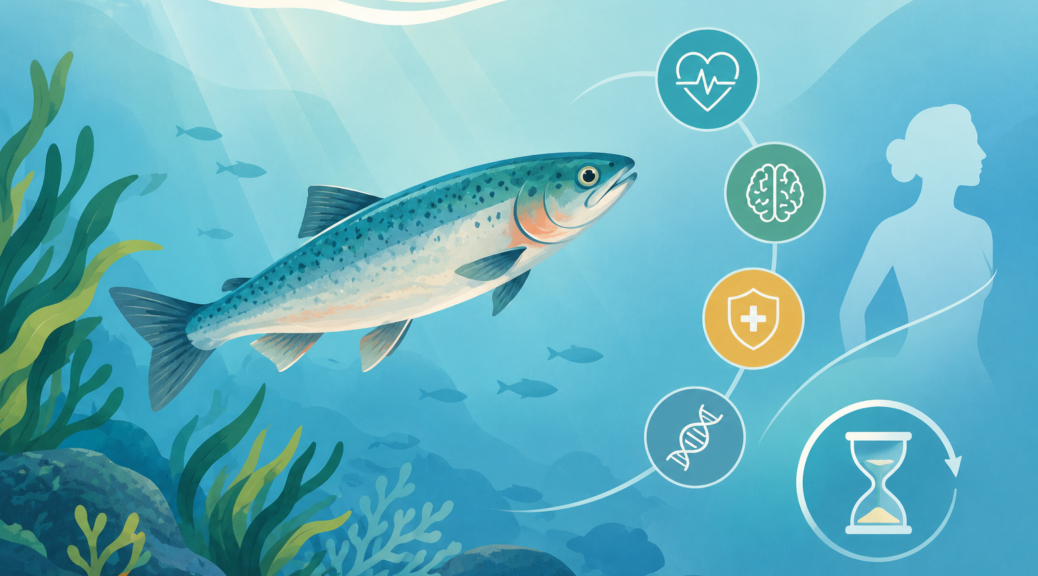
Fish are quietly rewriting what scientists thought they knew about aging. Buried in oceans and rivers around the world are creatures with some of the most extreme lifespans on the planet, from Greenland sharks that may live half a millennium to gold-flecked koi that outlast the humans who raise them. But it’s not just about record-breaking age. New research is showing that some of these long-lived species barely seem to age at all, defying the usual signs of physical decline, while their short-lived cousins are helping scientists study the aging process in fast-forward. Together, they’re offering some surprising clues about what determines a long life, and what one species’ habits in midlife might quietly reveal about its future.
Fish longevity
It varies enormously across species, and researchers have found it closely tied to environment, metabolism, and body size rather than simple evolutionary “advancement.” The Greenland shark represents the end of this spectrum, living an estimated 250 to 500 years in the frigid depths of the North Atlantic and Arctic Ocean, a lifespan scientists confirmed using radiocarbon dating of proteins in its eye lens. Cold, deep-water environments seem to be a recurring theme among long-lived fish, since slower metabolic rates in these conditions appear to reduce cellular damage over time; this pattern shows up in rockfish species, some of which live past 200 years, and in orange roughy, which can live 100 to 150 years.
Freshwater fish show similar extremes: lake sturgeon frequently live over a century, and the bigmouth buffalo was only recently confirmed through bomb radiocarbon dating to reach past 100 years, upending assumptions about typical freshwater fish lifespans. Longevity isn’t limited to wild, deep-sea, or freshwater giants either; ornamental and pet fish can also live surprisingly long with proper care, as seen in koi carp reportedly reaching over 200 years and goldfish regularly exceeding 30 years in captivity.
Scientists studying these species, especially the Greenland shark and orange roughy, are increasingly interested in what their slow aging and delayed maturity might reveal about aging biology more broadly, since these fish seem to avoid many of the typical signs of physiological decline seen in shorter-lived animals.
Current research
Recent research has shifted from simply cataloging which fish live longest toward understanding why, and some of the newest findings are upending assumptions about aging itself. A major 2026 study from Stanford, published in Science, tracked short-lived fish from adolescence to death and found that most fish experienced two to six rapid shifts in behavior, each lasting only a few days, rather than a slow, steady decline. Researchers discovered that simple midlife behaviors like movement and sleep patterns could predict lifespan, with fish that stayed active and slept mostly at night tending to live longer, and the team believes similar behavioral “clocks” tracked by wearables could eventually offer clues about human aging.
Separately, researchers studying bigmouth buffalo found striking evidence against the usual aging story: older fish showed less stress and greater immunity than younger fish, with no significant effect of age on telomere length, suggesting the species shows negligible senescence despite living for decades longer than most freshwater fish.
On the opposite end of the lifespan spectrum, scientists have turned to the turquoise killifish, one of the shortest-lived vertebrates, to study aging quickly. A 2026 study used its extremely short lifespan to identify key characteristics of immune aging within just a few weeks, with age-related changes especially evident in the kidney marrow, the fish equivalent of mammalian bone marrow, making it a fast model for testing anti-aging interventions.
There’s also ongoing work refining exactly how old fish get: a 2026 study used otolith analysis to document a new longevity record for spotted bass in a California reservoir, and separate radiocarbon-validation studies have been correcting long-held assumptions about supposedly short-lived reef fish like parrotfish.
Together, this research suggests fish are becoming an increasingly important model for aging science generally — both the ultra-long-lived species (for resisting senescence) and the ultra-short-lived ones (for studying aging fast).
Cave Fishes
They offer a natural experiment in longevity that echoes what researchers have found in other long-lived species. Living in permanently dark, nutrient-scarce environments, species like the Mexican tetra have evolved to lose their eyes and pigmentation, relying instead on heightened touch and vibration sensing to survive. But the more striking trade-off, from a longevity standpoint, is metabolic: cave environments favor a slower metabolism, delayed reproduction, and reduced energy expenditure, the same combination of traits linked to extended lifespans in deep-sea fish like the Greenland shark and orange roughy. This suggests that scarcity and stability, rather than danger or competition, may be one of evolution’s most reliable levers for slowing aging. Because the Mexican tetra exists in both a sighted surface form and a blind cave form of the same species, it gives scientists a rare opportunity to directly compare how the same genetic starting point diverges under different environmental pressures, offering more direct clues about what actually drives longer life in fish than cross-species comparisons alone can provide.
Short-Lived Fishes
Among the shortest-lived fish are Nothobranchius, or annual killifish, which have exceptionally brief lifespans of only a few months. Species such as Nothobranchius furzeri can live for around 4–6 months under laboratory conditions, making them one of the shortest-lived vertebrates known. They naturally inhabit temporary pools in Africa that dry up seasonally, so their life cycle is adapted to the short availability of water: they mature rapidly, reproduce, and die before the pools disappear, while their eggs remain dormant in the dried soil until the rains return. Gobies also include some very short-lived species, with certain species surviving for around a year. Because of their rapid aging and short generation times, Nothobranchius killifish are particularly valuable models for studying the biology of aging and potential longevity interventions.
Rockfish are a fascinating group of deep-sea fish known for their exceptionally long lifespans. Some species, particularly the rougheye rockfish (Sebastes aleutianus), can live for more than 200 years, making them among the longest-lived vertebrates known. They grow slowly, mature relatively late, and inhabit the cold, stable environments of the deep ocean, where their slow metabolism and reduced exposure to environmental stress may contribute to their remarkable longevity.
Conclusion:
From fish that can live for centuries to species that complete their entire lives in just a few months, fish reveal an extraordinary diversity of aging processes. Studying both extremes could offer interesting insights into why some organisms age rapidly while others maintain health for decades or even centuries. These remarkable species remind us that aging is not a universal process, but one that evolution has shaped in many different ways.
The good news of the month: Semaglutide may slow ageing and extend lifespan
A drug used to treat diabetes and obesity may also slow ageing. A new study published in Nature found that three months of semaglutide treatment in 20-month-old female mice improved physical function, reduced several hallmarks of ageing, and affected biological pathways involved in longevity. Continued treatment also extended lifespan, suggesting that GLP-1 receptor activation may reproduce some of the beneficial effects of calorie restriction and could provide new clues for developing interventions targeting ageing.
News of Heales and the Longevity Community: Healthy Ageing & Longevity Assembly 2026
Several important longevity events are coming up in the next few months.
The International Longevity Summit in Madrid will take place on 30 September and 1 October.
On 1 October, the “Promoting Healthy Ageing and Longevity” conference will take place in Brussels, with the participation of Valentina Palmisano, Member of the European Parliament.
From 1 to 3 October, the “Aging Research and Drug Discovery” (ARDD) conference will take place, where Shivani Kumar and Ninon Lecoquierre will present their work.
Finally, the 8th Eurosymposium on Healthy Ageing (EHA) will be held in Brussels on 5 and 6 November, bringing together researchers and experts to discuss the latest developments in healthy ageing and longevity.
For more information